ABOUT
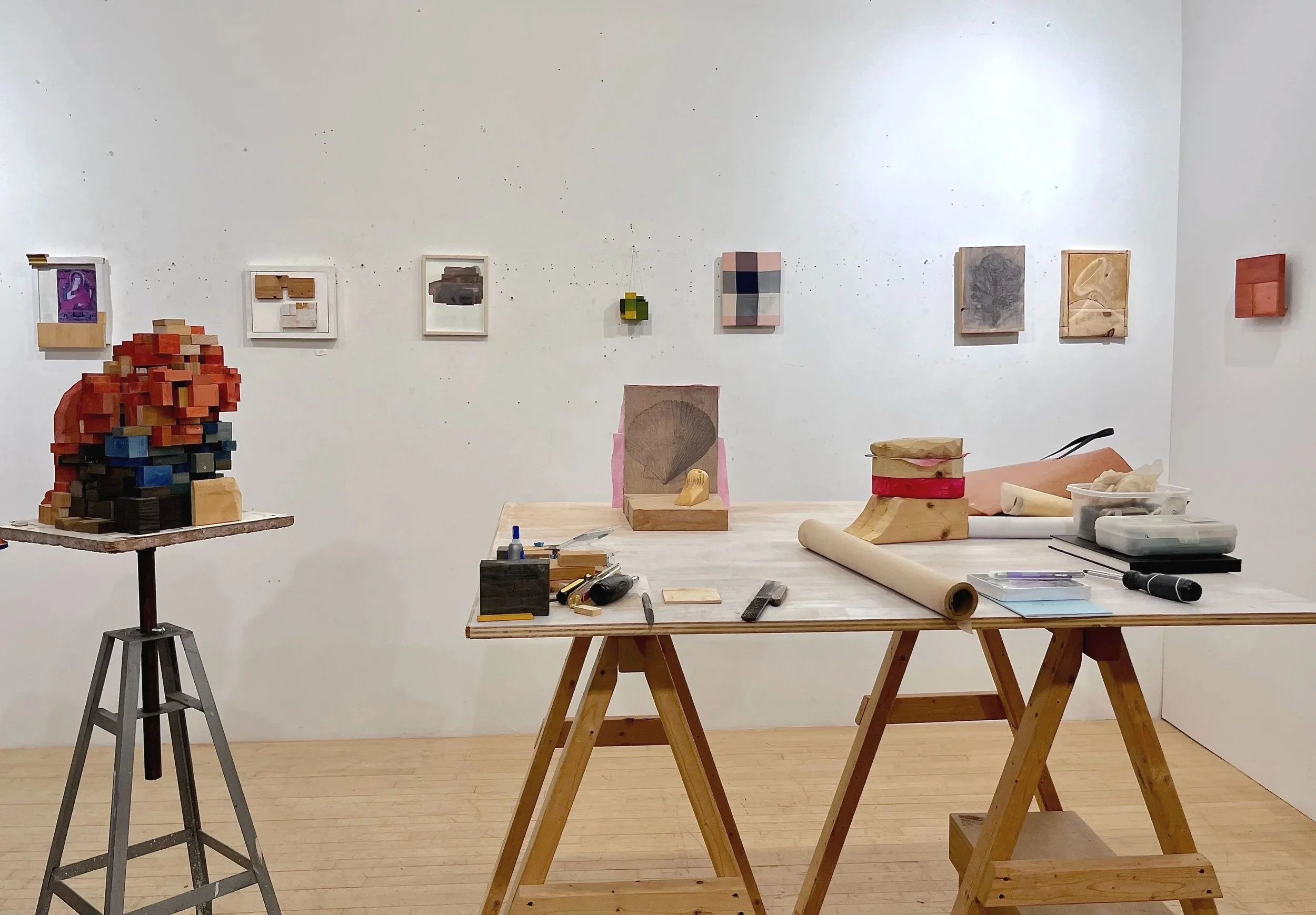
The whole of my studio is a site where disparate forms become an ensemble. Now there are small-scale wall and tabletop works; jewelry; furniture for walking mourners, and a boxed collection of wood scraps that remain from carving projects. The subject is nature and the nature of things. These works grow from and refer to each other, reflecting the studio as a place of non-literary interwoven interactions, where addition and subtraction are in dialogue, where one thing lets another make sense.
Drawing is central to my practice. I like knowing that this word (drawing) is a gerund—both noun and verb—because it represents a meaningful convergence of action and object. The "eye of my pencil" (Bridget Riley) guides me as I make observational studies and overlays, essential components in ensembles that display process, organic forms, bodies, cloth, adornment, and systems.
I choose to work with wood because it is its own subject. It exists in a bifurcated condition as it belongs to both the natural the constructed worlds. It is uncannily, tantalizingly both alive and dead. And, working with it is a haptic delight.
AN AUTOBIOGRAPHY
I was born in Omaha, Nebraska and was inspired by the idealism and pragmatism of the Pioneers who settled the Great Plains. My high school English teacher, Josephine Frisbie, lived in Red Cloud and spoke of seeing Willa Cather there. The artists I met at my mother’s gallery, the first in Omaha, inspired me to make art, but because I was a “good” student, I was encouraged to become a very intellectual art historian. Ultimately, I was drawn to studio practice and studied jewelry and metalsmithing, later, sculpture which explains my allegiance to both the applied and the fine arts. I am equally devoted to J D Prown’s material culture studies and the work of Constantin Brancusi.
I am a quiet activist. I made anti-war posters and a school soup kitchen with my fellow students at the Boston SMFA. Studying African tribal objects introduced me to Western imperialism when I was a Fellow at Mary Bunting Radcliffe Institute. I helped to found Boston’s Women’s Action Coalition (WAC). I have been a teacher in adult education classrooms and at MassArt, a public college for art and design. I recently retired after 47 years of teaching. I am a mother, a caregiver, and a widow. I cook for those in need.
When I was a young artist, I felt the conflict between my civic responsibilities and my all-consuming devotion to art making. My title for many works from that time, Living in Two Worlds notes this tension. My father called me a juggler! I can and do negotiate between these two spaces even as I treasure the soliloquy of my studio. It’s an arduous task. My studio is at the same time a haven and a vexing place. Still, I am grateful to inhabit this space of wonder and industry.